Repere conceptuale pentru gestionarea pădurilor cu rol social
DOI:
https://doi.org/10.4316/bf.2026.005Cuvinte cheie:
servicii ecosistemice, păduri cu rol social, păduri urbane și periurbane, planificare sustenabilă.Rezumat
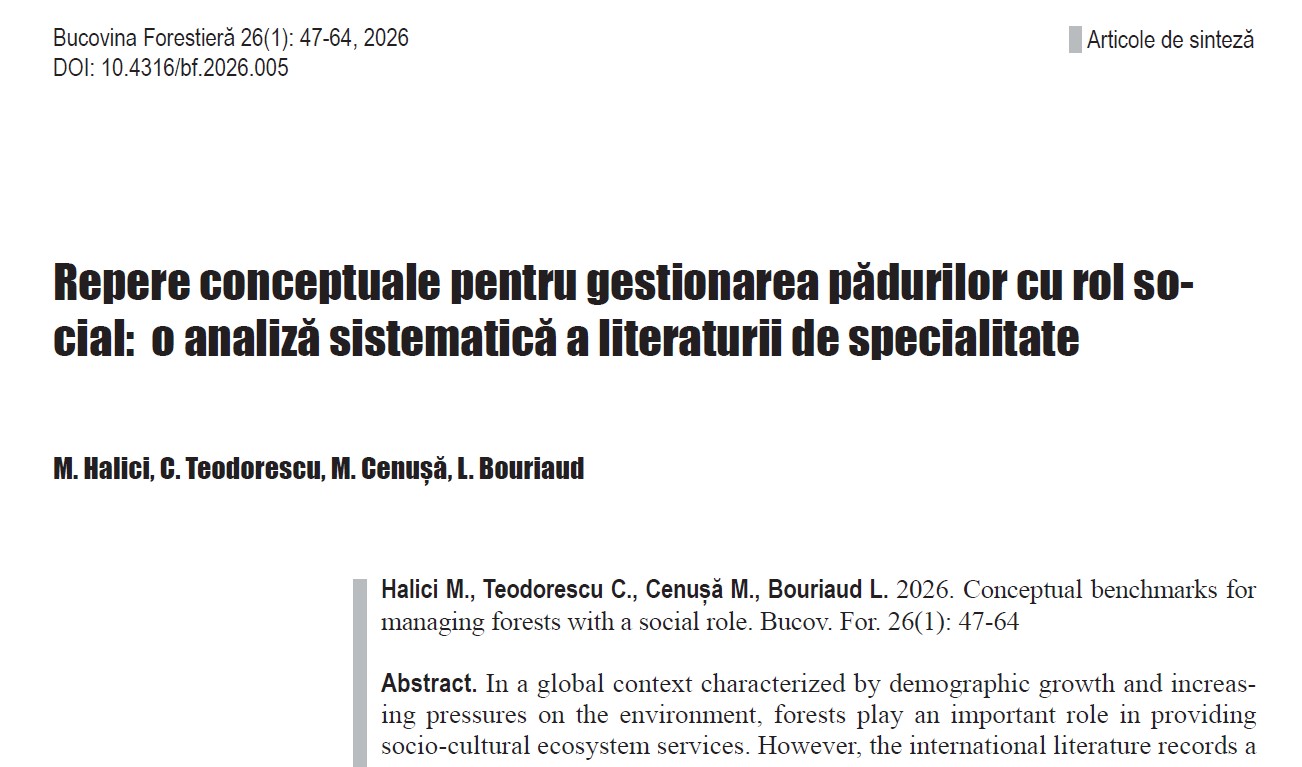
Într-un context global caracterizat de creștere demografică și presiuni tot mai accentuate asupra mediului, pădurile dețin un rol important în furnizarea serviciilor ecosistemice socio-culturale. Cu toate acestea, literatura internațională înregistrează un număr redus de studii despre pădurile cu rol social, iar în România cercetările în acest domeniu sunt și mai limitate. Studiul de față reprezintă una dintre primele analize sistematice realizate în România care abordează această tematică. Scopul cercetării este de a analiza literatura de specialitate referitoare la pădurile cu rol social, pentru a identifica tipurile de păduri definite ca având rol social, criteriile aplicate în desemnarea acestora și măsurile de gestionare propuse.
Prin analiza celor 93 de articole, s-au identificat direcții importante de cercetare privind pădurile cu rol social și s-a evidențiat modul în care dimensiunile sociale, instituționale și economice sunt integrate la nivelul literaturii de specialitate.
Cercetarea arată o dominanță a tematicii sociale, mai ales în cazul pădurilor urbane și periurbane, precum și o asociere între dimensiunea socială și cadrul instituțional. Rezultatele sugerează necesitatea unei abordări integrate în gestionarea ecosistemelor forestiere pentru fundamentarea și îmbunătățirea strategiilor de planificare și management pentru pădurile cu rol social din România.
Descărcări
Referințe
Affek A. N., Regulska E., Kołaczkowska E., Kowalska A., Affek K., 2021. Pollination potential of riparian hardwood forests—a multifaceted field-based assessment in the Vistula Valley, Poland. Forests, 12(7): 907. https://doi.org/10.3390/f12070907
Aznar-Sánchez J. A., Belmonte-Ureña L. J., López-Serrano M. J., Velasco-Muñoz J. F., 2018. Forest ecosystem services: An analysis of worldwide research. Forests, 9(8): 453. https://doi.org/10.3390/f9080453
Badiu D. L., Iojă C. I., Pătroescu M., et al., 2016. Is urban green space per capita a valuable target to achieve cities’ sustainability goals? Romania as a case study. Ecological Indicators, 70: 53-66. https://doi.org/10.1016/j.ecolind.2016.05.044
Baró F., Gómez-Baggethun E., Haase D., 2017. Ecosystem service bundles along the urban-rural gradient: insights for landscape planning and management. Ecosystem Services, 24: 147–159. https://doi.org/10.1016/j.ecoser.2017.02.021
Baró F., Haase D., Gómez-Baggethun E., Frantzeskaki N., 2015. Mismatches between ecosystem services supply and demand in urban areas: A quantitative assessment in five European cities. Ecological Indicators, 55: 146-158. https://doi.org/10.1016/j.ecolind.2015.03.013
Bernetti I., Chirici G., & Sacchelli S., 2019. Big data and evaluation of cultural ecosystem services: an analysis based on geotagged photographs from social media in Tuscan forest (Italy). IForest, 12: 98-105. https://doi.org/10.3832/ifor2821-011
Bilotta G. S., Milner A. M., Boyd I., 2014. On the use of systematic reviews to inform environmental policies. Environmental Science & Policy, 42: 67-77. https://doi.org/10.1016/j.envsci.2014.05.010
Blattert C., Lemm R., Thees O., Hansen J., Lexer M. J., Hanewinkel M., 2018. Segregated versus integrated biodiversity conservation: Value-based ecosystem service assessment under varying forest management strategies in a Swiss case study. Ecological Indicators, 95: 751-764. https://doi.org/10.1016/j.ecolind.2018.08.016
Blattert C., Mutterer S., Thrippleton T., Diaci J., Fidej G., Bont L. G., Schweier J., 2024. Managing European Alpine forests with close-to-nature forestry to improve climate change mitigation and multifunctionality. Ecological Indicators, 165: 112154. https://doi.org/10.1016/j.ecolind.2024.112154
Boncina A., 2011. Conceptual approaches to integrate nature conservation into forest management: a Central European perspective. International Forestry Review, 13(1): 13-22. https://doi.org/10.1505/ifor.13.1.13
Breyne J., Dufrêne M., Maréchal K., 2021. How integrating'socio-cultural values' into ecosystem services evaluations can give meaning to value indicators. Ecosystem Services, 49: 101278. https://doi.org/10.1016/j.ecoser.2021.101278
Burkart K., Meier F., Schneider A., et al., 2016. Modification of heat-related mortality in an elderly urban population by vegetation (urban green) and proximity to water (urban blue): evidence from Lisbon, Portugal. Environmental health perspectives, 124(7): 927-934.
Cabral P., Campos F. S., David J., Caser U., 2021. Disentangling ecosystem services perception by stakeholders: An integrative assessment based on land cover. Ecological Indicators, 126: 107660. https://doi.org/10.1016/j.ecolind.2021.107660
Campos P., Caparrós A., Oviedo J. L., et al., 2019. Bridging the gap between national and ecosystem accounting application in Andalusian forests, Spain. Ecological Economics, 157: 218-236. https://doi.org/10.1016/j.ecolecon.2018.11.017
Cimburova Z., Pont M. B., 2021. Location matters. A systematic review of spatial contextual factors mediating ecosystem services of urban trees. Ecosystem Services, 50: 101296. https://doi.org/10.1016/j.ecoser.2021.101296
Dabašinskas G., Sujetovienė G., 2024. Spatial and Temporal Changes in Supply and Demand for Ecosystem Services in Response to Urbanization: A Case Study in Vilnius, Lithuania. Land, 13(4): 454. https://doi.org/10.3390/land13040454
Diluiso F., Guastella G., Pareglio S., 2021. Changes in urban green spaces’ value perception: A meta-analytic benefit transfer function for European cities. Land Use Policy, 101: 105116. https://doi.org/10.1016/j.landusepol.2020.105116
Dupire S., Bourrier F., Monnet J. M., Bigot S., Borgniet L., Berger F., & Curt T., 2016. The protective effect of forests against rockfalls across the French Alps: Influence of forest diversity. Forest Ecology and Management, 382: 269-279. https://doi.org/10.1016/j.foreco.2016.10.020
Elsasser P., Altenbrunn K., Köthke M., Lorenz M., Meyerhoff J., 2021. Spatial distribution of forest ecosystem service benefits in Germany: A multiple benefit-transfer model. Forests, 12(2): 169. https://doi.org/10.3390/f12020169
Eriksson L., Nordlund A. M., Olsson O., & Westin K., 2012. Recreation in different forest settings: A scene preference study. Forests, 3(4): 923-943. https://doi.org/10.3390/f3040923
Evans D. L., Falagán N., Hardman C. A., Kourmpetli S., Liu L., Mead B. R., Davies J. A. C., 2022. Ecosystem service delivery by urban agriculture and green infrastructure–a systematic review. Ecosystem Services, 54: 101405. https://doi.org/10.1016/j.ecoser.2022.101405
Fagerholm N., Torralba M., Moreno G., et al., 2019. Cross-site analysis of perceived ecosystem service benefits in multifunctional landscapes. Global Environmental Change, 56: 134-147. https://doi.org/10.1016/j.gloenvcha.2019.04.002
Fontana V., Radtke A., Fedrigotti V. B., Tappeiner U., Tasser E., Zerbe S., Buchholz T., 2013. Comparing land-use alternatives: Using the ecosystem services concept to define a multi-criteria decision analysis. Ecological Economics, 93: 128-136. https://doi.org/10.1016/j.ecolecon.2013.05.007
García-Pardo K. A., Moreno-Rangel D., Domínguez-Amarillo S., García-Chávez J. R., 2022. Remote sensing for the assessment of ecosystem services provided by urban vegetation: A review of the methods applied. Urban Forestry & Urban Greening, 74: 127636. https://doi.org/10.1016/j.ufug.2022.127636
Getzner M., Gutheil-Knopp-Kirchwald G., Kreimer E., Kirchmeir H., Huber M., 2017. Gravitational natural hazards: Valuing the protective function of Alpine forests. Forest Policy and Economics, 80: 150-159. https://doi.org/10.1016/j.forpol.2017.03.015
Goméz A., Costa C., & Santana P., 2014. Acessibilidade e utilização dos espaços verdes urbanos nas cidades de Coimbra (Portugal) e Salamanca (Espanha). Finisterra, 49(97). https://doi.org/10.18055/Finis4207
Górriz-Mifsud E., Varela E., Piqué M., Prokofieva I., 2016. Demand and supply of ecosystem services in a Mediterranean forest: computing payment boundaries. Ecosystem services. 17: 53–63. https://doi.org/10.1016/j.ecoser.2015.11.006
Gren I. M., Amuakwa-Mensah F., 2018. Estimating economic value of site quality for uncertain ecosystem service provision in Swedish forests. International Journal of Biodiversity Science, Ecosystem Services & Management, 14(1): 117-126. https://doi.org/10.1080/21513732.2018.1472143
Grilli G., Ciolli M., Garegnani G., et al., 2017. A method to assess the economic impacts of forest biomass use on ecosystem services in a National Park. Biomass and Bioenergy, 98: 252-263. https://doi.org/10.1016/j.biombioe.2017.01.033
Guerrero P., Haase D., Albert C., 2022. Identifying spatial patterns and ecosystem service delivery of nature-based solutions. Environmental Management, 69(4): 735-751. https://doi.org/10.1007/s00267-022-01613-y
Haddaway N. R., Macura B., Whaley P., Pullin A. S., 2018. ROSES RepOrting standards for Systematic Evidence Syntheses: pro forma, flow-diagram and descriptive summary of the plan and conduct of environmental systematic reviews and systematic maps. Environmental Evidence, 7: 1-8. https://doi.org/10.1186/s13750-018-0121-7
Haines-Young R., Potschin M., 2013. Common International Classification of Ecosystem Services (CICES): Consultation on Version 4, August–December 2012. European Environment Agency (EEA), Copenhagen.
Hansen K., Malmaeus M., 2016. Ecosystem services in Swedish forests. Scandinavian Journal of Forest Research, 31(6): 626-640. https://doi.org/10.1080/02827581.2016.1164888
Hinsch M., Zulian G., Stekker S., Rega C., Nabuurs G. J., Verweij P., Burkhard B., 2024. Assessing pollinator habitat suitability considering ecosystem condition in the Hannover Region, Germany. Landscape Ecology, 39(3): 47. https://doi.org/10.1007/s10980-024-01851-x
Hölting L., Komossa F., Filyushkina A., et al., 2020. Including stakeholders’ perspectives on ecosystem services in multifunctionality assessments. Ecosystems and People, 16(1): 354-368. https://doi.org/10.1080/26395916.2020.1833986
Hörnsten L., Fredman P., 2000. On the distance to recreational forests in Sweden. Landscape and urban planning, 51(1): 1-10. https://doi.org/10.1016/S0169-2046(00)00097-9
Iraegui E., Augusto G., Cabral P., 2020. Assessing equity in the accessibility to urban green spaces according to different functional levels. ISPRS International Journal of Geo-Information, 9(5): 308. https://doi.org/10.3390/ijgi9050308
Jensen F. S., Koch N. E., 2004. Twenty-five years of forest recreation research in Denmark and its influence on forest policy. Scandinavian Journal of Forest Research, 19(S4): 93-102. https://doi.org/10.1080/14004080410034173
Jūrmalis E., Bārdule A., Donis J., Gerra-Inohosa L., Lībiete Z., 2023. Forest inventory data provide useful information for mapping ecosystem services potential. Land, 12(10): 1836. https://doi.org/10.3390/land12101836
Kalinauskas M., Bogdzevič K., Gomes E., Inácio M., Barcelo D., Zhao W., Pereira P., 2023. Mapping and assessment of recreational cultural ecosystem services supply and demand in Vilnius (Lithuania). Science of the Total Environment, 855: 158590. https://doi.org/10.1016/j.scitotenv.2022.158590
Kefalas G., Lorilla R. S., Xofis P., Poirazidis K., Eliades N. G. H., 2023. Landscape characteristics in relation to ecosystem services supply: the case of a Mediterranean Forest on the Island of Cyprus. Forests, 14(7): 1286. https://doi.org/10.3390/f14071286
Kirby M. G., Scott A. J., 2023. Multifunctional Green Belts: A planning policy assessment of Green Belts wider functions in England. Land Use Policy, 132: 106799. https://doi.org/10.1016/j.landusepol.2023.106799
Konijnendijk C.C., Randrup T.B., 2004. Urban forestry. În: Burley J., Evans J., Youngquist J.A. (eds.), Encyclopedia of Forest Sciences. Elsevier Science, London, pp. 471–478. https://doi.org/10.1016/B0-12-145160-7/00264-7
Koutsos T. M., Menexes G. C., Dordas C. A., 2019. An efficient framework for conducting systematic literature reviews in agricultural sciences. Science of the total environment, 682: 106-117. https://doi.org/10.1016/j.scitotenv.2019.04.354
Kowalska A., Affek A., Wolski J., et al., 2021. Assessment of regulating ES potential of lowland riparian hardwood forests in Poland. Ecological Indicators, 120: 106834. https://doi.org/10.1016/j.ecolind.2020.106834
Krsnik G., Reynolds K. M., Aquilué N., Mola-Yudego B., Pecurul-Botines M., Garcia-Gonzalo J., González Olabarria J. R., 2024. Assessing the dynamics of forest ecosystem services to define forest use suitability: a case study of Pinus sylvestris in Spain. Environmental Sciences Europe, 36(1): 128. https://doi.org/10.1186/s12302-024-00956-z
Legea nr. 2 din 30 octombrie 1987 privind conservarea, protejarea şi dezvoltarea pădurilor, exploatarea lor raţională economică şi menţinerea echilibrului ecologic. Buletinul Oficial nr. 52 din 9 noiembrie 1987. https://legislatie.just.ro/Public/DetaliiDocument/656
Legea nr. 24 din 15 ianuarie 2007 (**republicată**) privind reglementarea și administrarea spațiilor verzi din intravilanul localităților. Monitorul Oficial nr. 764 din 10 noiembrie 2009. https://legislatie.just.ro/public/detaliidocument/78673
Legea nr. 331/2024 privind Codul Silvic. Monitorul Oficial al României. 20 decembrie 2024.
Liepa L., Rendenieks Z., Jansons Ā., Miezīte O., Dubrovskis E., 2023. Mapping forest ecosystem service supply in two case studies in Latvia. Applied Geography, 155: 102969. https://doi.org/10.1016/j.apgeog.2023.102969
Lin J., Kroll C. N., Nowak D. J., Greenfield E. J., 2019. A review of urban forest modeling: Implications for management and future research. Urban forestry & urban greening, 43: 126366. https://doi.org/10.1016/j.ufug.2019.126366
Liu O. Y., Russo A., 2021. Assessing the contribution of urban green spaces in green infrastructure strategy planning for urban ecosystem conditions and services. Sustainable Cities and Society, 68: 102772. https://doi.org/10.1016/j.scs.2021.102772
Liu Y., Fan C., Xue D., 2024. A review of the effects of urban and green space forms on the carbon budget using a landscape sustainability framework. Sustainability, 16(5): 1870. https://doi.org/10.3390/su16051870
Lombardía A., Gómez-Villarino M. T., 2023. Green infrastructure in cities for the achievement of the un sustainable development goals: a systematic review. Urban Ecosystems, 26(6): 1693-1707. https://doi.org/10.1007/s11252-023-01401-4
Lopez M. A., De Marco A., Anav A., et al., 2025. The 3–30–300 rule Compliance: A geospatial tool for urban planning. Landscape and Urban Planning, 261: 105396. https://doi.org/10.1016/j.landurbplan.2025.105396
Lorilla R. S., Kalogirou S., Poirazidis K., Kefalas G., 2019. Identifying spatial mismatches between the supply and demand of ecosystem services to achieve a sustainable management regime in the Ionian Islands (Western Greece). Land Use Policy, 88: 104171. https://doi.org/10.1016/j.landusepol.2019.104171
Lundholm A., Black K., Corrigan E., Nieuwenhuis M., 2020. Evaluating the impact of future global climate change and bioeconomy scenarios on ecosystem services using a strategic forest management decision support system. Frontiers in Ecology and Evolution, 8: 200. https://doi.org/10.3389/fevo.2020.00200
Lwasa S., Mugagga F., Wahab B., Simon D., Connors J. P., Griffith C., 2015. A meta-analysis of urban and peri-urban agriculture and forestry in mediating climate change. Current Opinion in Environmental Sustainability, 13: 68-73. https://doi.org/10.1016/j.cosust.2015.02.003
Maebe L., Dufrêne M., Pipart N., Dendoncker N., Boeraeve F., 2015. Wal-ES: Walloon platform on Ecosystem Services. In 2ème Congrès interdisciplinaire du développement durable.
Mathys A. S., Bottero A., Stadelmann G., Thürig E., Ferretti M., Temperli C., 2021. Presenting a climate-smart forestry evaluation framework based on national forest inventories. Ecological Indicators, 133: 108459. https://doi.org/10.1016/j.ecolind.2021.108459
McPhearson T., Kremer P., Hamstead Z. A., 2013. Mapping ecosystem services in New York City: Applying a social–ecological approach in urban vacant land. Ecosystem Services, 5: 11-26. https://doi.org/10.1016/j.ecoser.2013.06.005
Mina M., Bugmann H., Cordonnier T., Irauschek F., Klopcic M., Pardos M., Cailleret M., 2017. Future ecosystem services from European mountain forests under climate change. Journal of Applied Ecology, 54(2): 389-401. https://doi.org/10.1111/1365-2664.12772
Mori S., Pacetti T., Brandimarte L., Santolini R., Caporali E., 2021. A methodology for assessing spatio-temporal dynamics of flood regulating services. Ecological Indicators, 129: 107963. https://doi.org/10.1016/j.ecolind.2021.107963
Müller A., Knoke T., Olschewski R., 2019. Can existing estimates for ecosystem service values inform forest management?. Forests, 10(2): 132. https://doi.org/10.3390/f10020132
Mundher R., Abu Bakar S., Maulan S., Mohd Yusof M. J., et al., 2022. Aesthetic quality assessment of landscapes as a model for urban forest areas: A systematic literature review. Forests, 13(7): 991. https://doi.org/10.3390/f13070991
Nesbitt L., Hotte N., Barron S., Cowan J., Sheppard S. R., 2017. The social and economic value of cultural ecosystem services provided by urban forests in North America: A review and suggestions for future research. Urban Forestry & Urban Greening, 25: 103-111. https://doi.org/10.1016/j.ufug.2017.05.005
Oku H., Fukamachi K., 2006. The differences in scenic perception of forest visitors through their attributes and recreational activity. Landscape and urban Planning, 75(1-2): 34-42. https://doi.org/10.1016/j.landurbplan.2004.10.008
Orsi F., Ciolli M., Primmer E., Varumo L., Geneletti D., 2020. Mapping hotspots and bundles of forest ecosystem services across the European Union. Land use policy, 99: 104840. https://doi.org/10.1016/j.landusepol.2020.104840
Page M. J., McKenzie J. E., Bossuyt P. M., et al., 2021. The PRISMA 2020 statement: an updated guideline for reporting systematic reviews. BMJ: 372. https://doi.org/10.1136/bmj.n71
Paletto A., De Meo I., Grilli G., Nikodinoska N., 2017. Effects of different thinning systems on the economic value of ecosystem services: A case-study in a black pine peri-urban forest in Central Italy. Annals of Forest Research, 60(2): 313-326. https://doi.org/10.15287/afr.2017.799
Pardos M., Pérez S., Calama R., Alonso R., Lexer M. J., 2017. Ecosystem service provision, management systems and climate change in Valsaín forest, central Spain. Regional environmental change, 17(1): 17-32. https://doi.org/10.1007/s10113-016-0985-4
Park B. J., Tsunetsugu Y., Kasetani T., Morikawa T., Kagawa T., Miyazaki Y., 2009. Physiological effects of forest recreation in a young conifer forest in Hinokage Town, Japan. Silva Fenn, 43(2): 291-301. https://doi.org/10.14214/sf.213
Pereira P., Inácio M., Pinto L., Kalinauskas M., Bogdzevic K., Zhao W., 2024. Mapping ecosystem services in urban and peri-urban areas. A systematic review. Geography and Sustainability, 5(3): 491-509. https://doi.org/10.1016/j.geosus.2024.06.002
Perevochtchikova M., Flores J. Á. H., Marín W., Flores A. L., Bueno A. R., Negrete I. A. R., 2019. Systematic review of integrated studies on functional and thematic ecosystem services in Latin America, 1992–2017. Ecosystem Services, 36: 100900. https://doi.org/10.1016/j.ecoser.2019.100900
Pintilii R. D., 2022. Forest recreation and landscape protection. Forests, 13(9): 1440.
Pomara L. Y., Lee D. C., 2021. The role of regional ecological assessment in quantifying ecosystem services for forest management. Land, 10(7): 725. https://doi.org/10.3390/land10070725
Pulighe G., Fava F., Lupia F., 2016. Insights and opportunities from mapping ecosystem services of urban green spaces and potentials in planning. Ecosystem services, 22: 1-10. https://doi.org/10.1016/j.ecoser.2016.09.004
Rakatama A., Pandit R., 2020. Reviewing social forestry schemes in Indonesia: Opportunities and challenges. Forest policy and economics, 111: 102052. https://doi.org/10.1016/j.forpol.2019.102052
Riecken U., Ullrich K., Lang A., 2006. A vision for the Green Belt in Europe. The Green Belt of Europe-From Vision to Reality. Terry A., Ullrich K., Riecken U. Gland, Switzerland and Cambridge, UK, IUCN: 3-10.
Ritter E., Dauksta D., 2013. Human–forest relationships: ancient values in modern perspectives. Environment, development and sustainability, 15: 645-662. https://doi.org/10.1007/s10668-012-9398-9
Russo A., Cirella G. T., 2018. Modern compact cities: how much greenery do we need?. International journal of environmental research and public health, 15(10): 2180. https://doi.org/10.3390/ijerph15102180
Sahide M. A. K., Fisher M. R., Erbaugh J. T., et al., 2020. The boom of social forestry policy and the bust of social forests in Indonesia: Developing and applying an access-exclusion framework to assess policy outcomes. Forest Policy and Economics, 120: 102290. https://doi.org/10.1016/j.forpol.2020.102290
Sampaio M. B., De La Fuente M. F., Albuquerque U. P., da Silva Souto A., Schiel N., 2018. Contact with urban forests greatly enhances children’s knowledge of faunal diversity. Urban forestry & urban greening, 30: 56-61. https://doi.org/10.1016/j.ufug.2018.01.006
Sauter I., Kienast F., Bolliger J., Winter B., Pazúr R., 2019. Changes in demand and supply of ecosystem services under scenarios of future land use in Vorarlberg, Austria. Journal of Mountain Science, 16(12): 2793-2809. https://doi.org/10.1007/s11629-018-5124-x
Schaubroeck T., Deckmyn G., Giot O., et al., 2016. Environmental impact assessment and monetary ecosystem service valuation of an ecosystem under different future environmental change and management scenarios; a case study of a Scots pine forest. Journal of environmental management, 173: 79-94. https://doi.org/10.1016/j.jenvman.2016.03.005
Schröter M., Barton D. N., Remme R. P., Hein L., 2014. Accounting for capacity and flow of ecosystem services: A conceptual model and a case study for Telemark, Norway. Ecological Indicators, 36: 539-551. https://doi.org/10.1016/j.ecolind.2013.09.018
Selbig W. R., Loheide II S. P., Shuster W., et al., 2022. Quantifying the stormwater runoff volume reduction benefits of urban street tree canopy. Science of the Total Environment, 806: 151296. https://doi.org/10.1016/j.scitotenv.2021.151296
Siedentop S., Fina S., Krehl A., 2016. Greenbelts in Germany's regional plans—An effective growth management policy?. Landscape and Urban Planning, 145: 71-82. https://doi.org/10.1016/j.landurbplan.2015.09.002
Sil Â., Fernandes P. M., Rodrigues A. P., Alonso J. M., Honrado J. P., Perera A., Azevedo J. C., 2019. Farmland abandonment decreases the fire regulation capacity and the fire protection ecosystem service in mountain landscapes. Ecosystem Services, 36: 100908. https://doi.org/10.1016/j.ecoser.2019.100908
Simion H., Giombini V., Tasser E., Marsoner T., Egarter Vigl L., 2023. Enhancing understanding of ecosystem multifunctionality in mountain regions. Ecological Solutions and Evidence, 4(3): e12265. https://doi.org/10.1002/2688-8319.12265
Szczepańska A., Senetra A., 2019. Forests as the key component of green belts surrounding urban areas. Baltic Forestry, 25(1). https://doi.org/10.46490/vol25iss1pp141
Tarasewicz N. A., Jönsson A. M., 2021. An ecosystem model based composite indicator, representing sustainability aspects for comparison of forest management strategies. Ecological Indicators, 133: 108456. https://doi.org/10.1016/j.ecolind.2021.108456
Tekalign M., Van Meerbeek K., Aerts R., Norgrove L., Poesen J., Nyssen J., Muys B., 2017. Effects of biodiversity loss and restoration scenarios on tree-related ecosystem services. International Journal of Biodiversity Science, Ecosystem Services & Management, 13(1): 434-443. https://doi.org/10.1080/21513732.2017.1399929
Temperli C., Blattert C., Stadelmann G., Brändli U. B., Thürig E., 2020. Trade-offs between ecosystem service provision and the predisposition to disturbances: a NFI-based scenario analysis. For Ecosyst 7: 27. https://doi.org/10.1186/s40663-020-00236-1
Thompson S. W., Rogerson D., Ruddock A., Barnes A., 2020. The effectiveness of two methods of prescribing load on maximal strength development: a systematic review. Sports Medicine, 50(5): 919-938. https://doi.org/10.1007/s40279-019-01241-3
Tiemann A., Ring I., 2022. Towards ecosystem service assessment: developing biophysical indicators for forest ecosystem services. Ecological Indicators, 137: 108704. https://doi.org/10.1016/j.ecolind.2022.108704
Washbourne C. L., Goddard M. A., Le Provost G., Manning D. A., & Manning P., 2020. Trade-offs and synergies in the ecosystem service demand of urban brownfield stakeholders. Ecosystem Services, 42: 101074. https://doi.org/10.1016/j.ecoser.2020.101074
Wolf K. L., Lam S. T., McKeen J. K., Richardson G. R., van Den Bosch M., Bardekjian A. C., 2020. Urban trees and human health: A scoping review. International journal of environmental research and public health, 17(12): 4371. https://doi.org/10.3390/ijerph17124371
Wübbelmann T., Bouwer L., Förster K., Bender S., Burkhard B., 2022. Urban ecosystems and heavy rainfall–A Flood Regulating Ecosystem Service modelling approach for extreme events on the local scale. One Ecosystem, 7: e87458. https://doi.org/10.3897/oneeco.7.e87458
Yaneva R., Zhiyanski M., Dodev Y., 2022. Bioaccumulation of potentially toxic elements within the soil–plant system in Central Balkan region: analysis of the forest ecosystem capacity to mediate toxic elements. Environmental Geochemistry and Health, 44(2): 563-577. https://doi.org/10.1007/s10653-020-00756-3
Descărcări
Publicat
Cum cităm
Număr
Secțiune
Licență
Copyright (c) 2026 Medeea - Cătălina Halici, Cerasela Teodorescu, Marina Cenușă, Laura Bouriaud

Această lucrare este licențiată în temeiul Creative Commons Attribution-NonCommercial 4.0 International License.
Licența Open Access
Toate articolele și materialele suplimentare publicate în revista BUCOVINA FORESTIERĂ sunt disponibile sub o politică de acces liber gratuit (Open Access Licence) descrisă de BOAI, ceea ce implică accesul liber (fără nici o taxă) și nelimitat, pentru toată lumea, la conținutul integral al acestora.
Publicarea manuscriselor este gratuită, toate cheltuielile fiind suportate de către Facultatea de Silvicultură din cadrul Universități „Ștefan cel Mare” din Suceava.